Securing Endpoint Devices for Western Sydney’s Mobile Workforce
Mobile and hybrid work are now standard for many Western Sydney businesses. Staff are jumping between offices, home, client sites, warehouses, and job locations, often using a mix of laptops, phones and tablets to keep work moving. That flexibility is great for productivity, but it also opens more doors for cyber threats if devices are not properly secured.
In this article, we look at how endpoint security in Sydney can protect your people and data without slowing anyone down. We focus on simple, practical steps that suit construction, logistics, professional services and field-based teams that need to get work done out on the road, not just behind a desk.
Secure Mobile Workforces Without Slowing Them Down
Western Sydney businesses depend on mobile workforces to deliver projects and services on time. As days warm up and project timelines tighten, it is common to see more site visits, client meetings and fieldwork. During these busy periods, new devices are often added in a hurry and personal phones may start to creep into daily workflows.
That is where the risk grows. Unsecured laptops, mobiles and tablets can become easy ways into your email, finance systems, client files and cloud apps. Often, staff are simply trying to get their work done and do not realise that one quick shortcut, like using a public Wi-Fi network, can put the business at risk.
The goal is not to lock everything down so tightly that work becomes painful. Strong endpoint security should:
- Protect sensitive data wherever staff are working
- Support compliance with industry and client expectations
- Keep devices stable and reliable, without constant interruptions
When security is planned properly, it becomes part of the background. Your team focuses on the job, while controls quietly reduce risk.
Why Mobile Endpoints Are Now Your Primary Risk Surface
When we talk about endpoints, we mean any device staff use to access business systems. This includes:
- Laptops and desktop PCs
- Smartphones and tablets
- Remote desktops or virtual machines used from home or client sites
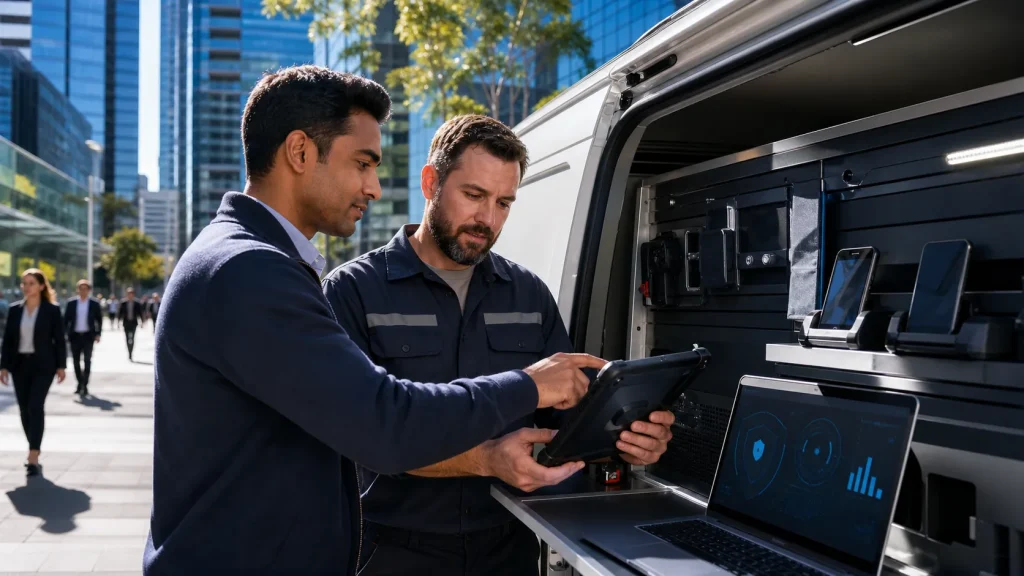
These can be company-owned devices or personal ones used for work. In Western Sydney, that might look like a site supervisor hotspotting from a phone in Penrith, a consultant working in a Parramatta café, a driver using a tablet in the truck, or managers moving between local offices and the CBD.
Common weaknesses we see include:
- Devices that have not installed recent security updates
- Personal phones checking work email with no controls in place
- Weak passwords reused across different systems
- No multi-factor authentication to add an extra layer of protection
A single compromised device is rarely just an IT problem. It can lead to data loss, privacy and regulatory concerns, reputational damage with clients and unplanned downtime for teams who suddenly cannot access what they need. That flow-on effect can quickly hit revenue and project delivery.
Building a Practical Endpoint Security Framework
Many smaller and mid-sized businesses assume that strong endpoint security requires a large internal IT team. It does not. What matters is a clear, consistent framework that fits how your business actually works.
Key building blocks include:
- Standardised device setup, so every laptop and mobile follows the same security baseline
- Managed antivirus and anti-malware, centrally monitored, instead of leaving staff to manage their own tools
- Multi-factor authentication on email, remote access and key cloud apps
- Full-disk encryption on devices, so lost or stolen hardware cannot expose client or business data
In simple terms, this framework helps you:
- Lower the chance of a successful attack
- Limit how far an attacker can go if they do get in
- Keep devices stable, so staff can work from anywhere with fewer issues
This type of structure also fits naturally into proactive IT management. Instead of reacting to each problem, you build a predictable, fixed set of controls that can be monitored and improved over time.
Making Endpoint Security Work for Remote and Field Teams
Security cannot only work for office staff sitting on a fast, stable network. It has to support people in utes, on job sites and in client boardrooms across Western Sydney.
Practical measures that help mobile and field teams include:
- Secure remote access, such as a VPN or secure gateway, that creates a private tunnel into your systems even when staff are on public or home networks
- Application control, so staff use approved, supported tools rather than random file-sharing apps or unsanctioned cloud services
- Role-based access, so each person only sees the data and systems they genuinely need to do their job
Technology is only half the answer. Clear, short training in plain English makes a big difference. Staff should know:
- How to spot and report suspicious emails or messages
- What to do if a device is lost, stolen or left in a vehicle
- When public Wi-Fi is unsafe, and safer options to use instead
When controls and guidance are set up thoughtfully, businesses see fewer interruptions, smoother handovers between office and field teams, and better response times for clients, without a constant worry that mobile work is expanding risk.
Monitoring, Response and Business Continuity
Endpoint security in Sydney cannot be a one-off project. Staff change roles, contractors come and go, and new locations or cloud apps are added. Without ongoing monitoring, gaps open up quickly.
A sound approach includes:
- Central dashboards that show device health, patch status and security alerts in one place
- Agreed response runbooks so your leaders and IT partner know the exact steps to follow if a device is compromised or goes missing
- Regular, easy-to-read reports that translate technical details into clear business decisions
Endpoints also link directly to your wider business continuity plans. Managed backups, tested restores and the ability to lock or wipe a device remotely mean you can protect data while keeping operations running. If a laptop is lost, your team can keep working from another device, instead of being stuck for days.
A long-term partnership with a local managed IT provider helps keep these settings aligned with the way your business is growing, whether you add new depots, expand your field teams or adopt new cloud platforms.
Getting Your Endpoint Security Ready for the Year Ahead
It pays to step back once or twice a year and run a structured review of your endpoint security, especially before busy trading periods or major project pushes. A simple review might:
- List every device that accesses business systems, including contractor and personal mobiles
- Check which devices are missing updates, antivirus, encryption or multi-factor authentication
- Prioritise quick wins, such as enforcing stronger passwords or rolling out encryption, that deliver strong risk reduction with minimal disruption
For Western Sydney businesses, working with a local team that understands common industries and on-the-ground realities can make these reviews more practical and less theoretical. Simplicity I.T. focuses on proactive IT management, cybersecurity protection and business continuity, delivered as predictable, fixed-cost support that fits how real teams work.
By treating endpoint security as a core part of everyday operations, rather than an afterthought, you give your mobile workforce the confidence to work from anywhere, while your data and systems stay protected.
Protect Your Business With Proactive Endpoint Security Today
If you are ready to close the gaps in your cybersecurity and safeguard every device your team relies on, we are here to help. At Simplicity I.T., we design and manage tailored endpoint security in Sydney that fits the way your business actually works. Talk to us about your current setup, and we will recommend practical next steps to strengthen your defences. To get started, simply contact us and book a time with our team.