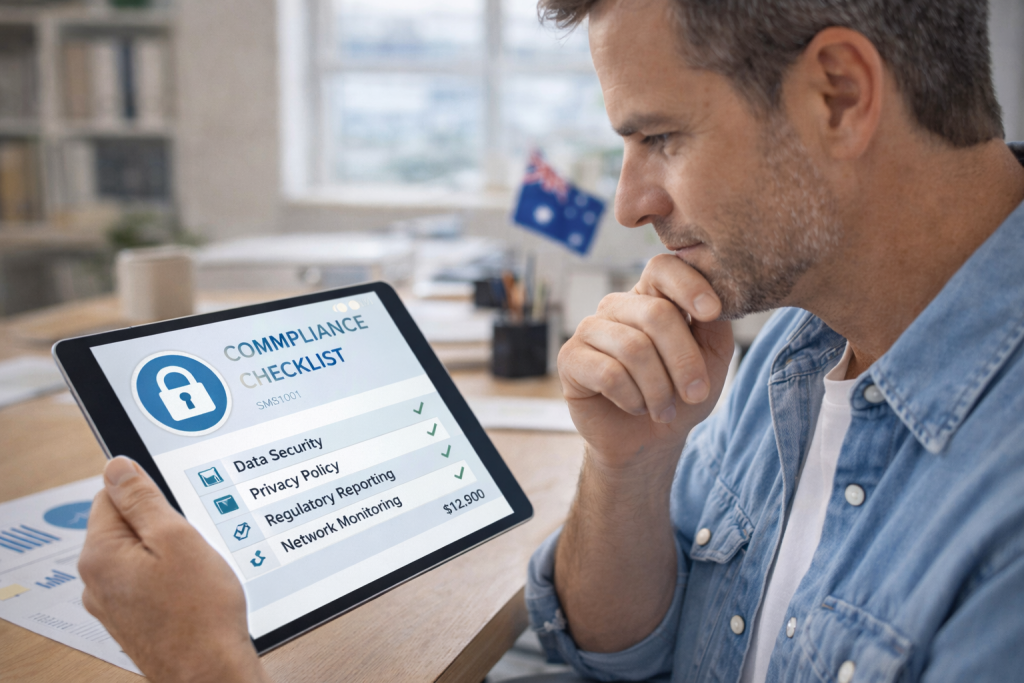
In 2026, the Australian government introduced SMB1001 — a national I.T. compliance benchmark specifically designed for small to mid-sized businesses.
The aim? To create a standardised, scalable framework that helps SMEs:
- Protect customer data
- Mitigate cyber threats
- Align with broader national security standards.
SMB1001 applies to any Australian business with: – 5 to 200 employees, or – Annual turnover between $500,000 and $50 million, or – Access to customer data via cloud platforms, email, or online forms.
If that sounds like your business — keep reading.
Why SMB1001 Was Introduced
Until recently, most cybersecurity standards (like CPS 234 or ISO 27001) were designed for large enterprises or regulated industries.
But cybercrime doesn’t discriminate. And small businesses are now: –
- Frequently targeted in phishing
- ransomware
- and supply chain attacks
Holding sensitive data — often with weaker defences – Working with bigger clients who require evidence of baseline protections.
SMB1001 was created to bridge the gap — to give SMEs a clear, realistic roadmap to modern I.T. compliance.
What SMB1001 Requires (in Plain English)
The framework is designed to be achievable — and focuses on six core pillars:
- Identity & Access Management
Who has access to your systems? Are accounts secured with MFA? - Data Protection
Are your files backed up, encrypted, and stored securely? - Device & Endpoint Security
Are laptops, phones, and other devices protected — even remotely? - Email & Communication Security
Are phishing filters, spam controls, and secure email tools in place? - Incident Response Readiness
Do you have a documented plan for cyber incidents or data breaches? - Staff Awareness & Training
Have your employees been trained on spotting threats and handling data?
No jargon. No 100-page PDFs. Just practical protections — backed by policy.
Penalties and Pressures — Even If You’re Not “Regulated”
While SMB1001 isn’t currently enforced by fines, it’s already being used as a baseline compliance standard by:
- Cyber insurance providers
- Larger corporate clients
- and supply chain partners
- Government tender panels.
Failing to meet SMB1001 could soon impact your ability to: – Win contracts – Get covered for cyber incidents – Defend your brand reputation after a breach.
“We’re Just a Small Business” — That’s Why SMB1001 Exists
This framework was designed for you — not for banks or enterprises. It recognises that: – You don’t have in-house cybersecurity teams – You still hold sensitive data – You need a path that balances protection with budget.
That’s where Simplicity I.T. comes in.
How We Help SMEs Meet SMB1001 With Confidence
We make compliance practical, not painful. Our approach includes: – A full gap assessment mapped to SMB1001 pillars – Implementing key protections like MFA, backups, and endpoint security – Providing staff training and policy templates – Creating an action plan you can show insurers, boards, or clients.
You’ll be audit-ready, protected, and confident — without the overwhelm.
How to Know If You’re Falling Short
You might be non-compliant (without realising) if:
- You don’t have documented I.T. policies
- Staff share logins or reuse weak passwords
- You use Gmail/Outlook for business with no MFA
- Backups are “set and forget” with no regular testing
- There’s no plan if something goes wrong
These are common — but fixable.
Let’s Make SMB1001 Work For You
This isn’t about red tape. It’s about resilience.
If you want to:
- Prove your business takes data seriously
- Protect your customers, staff, and systems
- Future-proof your operations and reputation
Book a free SMB1001 compliance check with Simplicity I.T. — and take the guesswork out of protecting your business.