
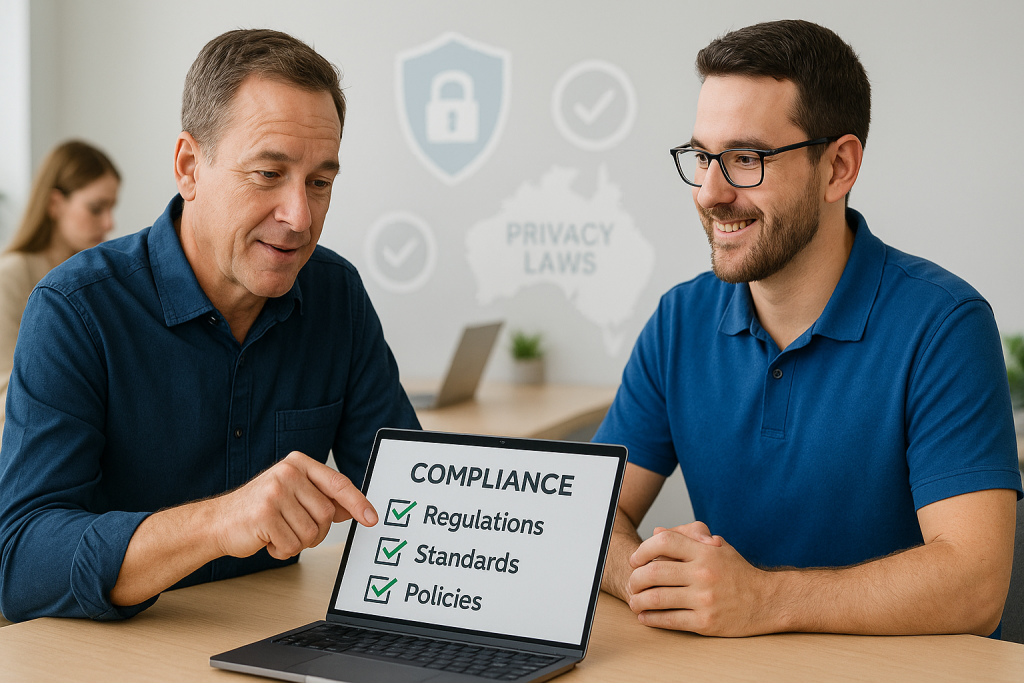
When it comes to I.T. compliance, most small business owners assume it’s only a concern for big corporations or government agencies.
But here’s the reality: if your business stores data, accepts payments, or uses digital tools — you have compliance responsibilities.
And ignoring them can lead to fines, data breaches, and reputational damage.
Here’s a clear, plain-English guide to help you understand your I.T. compliance obligations in Australia — and how to meet them without getting overwhelmed.
What Is I.T. Compliance, Really?
I.T. compliance means ensuring your business’s technology, systems, and data practices follow relevant laws, standards, and best practices.
In Australia, this often includes: – Privacy laws (like the Privacy Act 1988 and APPs) – Cybersecurity frameworks (e.g. Essential Eight, ISO27001) – Industry-specific rules (e.g. healthcare, finance, legal) – Payment security (e.g. PCI-DSS for processing credit cards).
Put simply: if you’re handling sensitive information, you have legal and ethical duties to protect it.
Who Needs to Worry About I.T. Compliance?
Many SME owners think compliance only applies to big players. But that’s a costly misconception.
You likely need to pay attention if: – You collect customer names, emails, or payment info – You run an eCommerce site or online booking system – You use cloud platforms to store business data – You work with clients in regulated industries – You have remote/hybrid staff accessing systems offsite.
Even a small marketing firm, retailer, or tradie business can face risk if systems aren’t secured properly.
📋 Quick Overview: I.T. Compliance for SMEs
In Australia, small businesses must comply with data privacy laws, secure sensitive information, and use technology responsibly. This includes the Privacy Act, PCI-DSS (if you accept card payments), and essential cybersecurity measures.
5 Key Compliance Areas to Focus On
1. Privacy and Data Collection
Make sure: – You have a clear privacy policy – You only collect data you actually need – You tell people how their data is stored and used.
2. Access Control and User Management
- Use strong passwords and MFA (multi-factor authentication)
- Set role-based access for staff
- Remove access when people leave the business
3. Data Storage and Backups
- Know where your data lives (especially if it’s in the cloud)
- Use encrypted backups
- Test recovery processes regularly
4. Cybersecurity Defences
- Implement the Australian Cyber Security Centre’s Essential Eight
- Use antivirus, firewalls, and endpoint protection
- Keep software patched and updated
5. Staff Training and Awareness
- Train your team on phishing, data handling, and security hygiene
- Create simple policies they understand and follow
What Happens If You’re Non-Compliant?
Even unintentional non-compliance can result in: – Fines or penalties from the OAIC or regulators – Lawsuits or insurance issues after a breach – Loss of contracts (especially with larger clients) – Reputational harm and loss of customer trust.
Prevention is far cheaper than damage control.
How Simplicity I.T. Helps SMEs Stay Compliant
We help businesses meet their compliance obligations through: – Privacy and risk assessments – Secure cloud setup and access controls – Regular software patching and backups – Staff training and documentation – Guidance tailored to your industry or risk level.
You don’t have to navigate it alone — we simplify the process and make compliance achievable.
Not Sure Where You Stand?
We offer a free compliance check-up to: – Review your current risks – Identify easy wins to improve security – Help you avoid costly oversights.
👉 Book your free strategy session
Or explore our Compliance & Cybersecurity Services
I.T. compliance isn’t just about ticking boxes. It’s about protecting your business, your clients, and your future.